
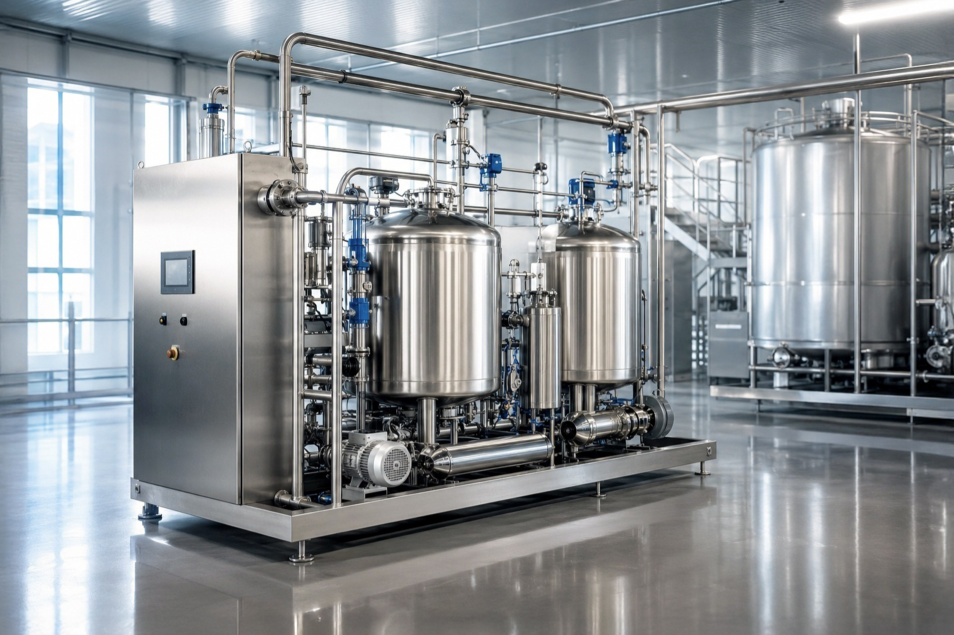
GreenCIP chemical recovery unit

An existing CIP installation can function well technically while at the same time causing high operational costs. Every cleaning cycle requires chemicals, water and energy, and leads to costs for neutralisation and wastewater treatment. GreenCIP regenerates used CIP caustic and makes it reusable within the existing cleaning installation.

The chemical recovery unit is integrated as a separate process module, without the need to replace the existing CIP installation. The result is a structural reduction in the consumption of chemicals, water and energy, combined with a lower wastewater load.

  • Up to 80% fewer chemicals
  • Up to 50% less water
  • Up to 30% less energy
  • Up to 90% reuse of treated caustic
  • Lower operational costs, higher returns
  • Payback period from approx. 18 months


Up to 80% fewer chemicals

Used caustic is regenerated and reused.

Up to 90% reuse of treated caustic

NaOH stays in the process longer.

Payback period from approx. 18 months

Savings with every CIP cycle.


Chemical recovery as part of process optimisation

Your CIP does its job. But do you also know at what cost? During every CIP cycle, the contamination level of the caustic cleaning solution increases due to product residues and organic load. As soon as the solution no longer meets the required process conditions, it is usually discharged and replaced with fresh NaOH.

This not only leads to costs for new chemicals. Water consumption, energy for heating, neutralisation and wastewater treatment also increase.

GreenCIP adds a regeneration step to this existing process. Used caustic cleaning solution is treated, after which a large part of it can be reused.

CIP installation → Used caustic → GreenCIP regeneration → Regenerated caustic → Reuse

Depending on the application, up to 90% of the treated caustic can be reused. As a result, the NaOH present remains in the process for longer and the need for new cleaning chemicals decreases.
Chemical recovery without membrane technology

Various technical solutions are available for recovering CIP chemicals. Some of the available systems use membrane technology to remove contamination from used cleaning solutions. This technology can be effective, but it also entails recurring costs for membrane replacement, maintenance and membrane-specific consumables.

Disadvantages of membrane technology

  • Higher water consumption due to periodic cleaning of the membranes
  • Higher energy consumption due to pressure drop across the membranes
  • No neutralisation of organic material, so the wastewater load remains

GreenCIP deliberately opts for a membrane-free regeneration process

  • No periodic membrane replacement
  • No membrane-specific consumables
  • Lower recurring replacement costs
  • Less dependence on membrane performance
From technical recovery to financial business case

From technical recovery to financial business case

The recovery rate alone does not determine whether an investment is attractive. That is why the GreenCIP business case is based on the actual process data of the production environment, taking into account both the potential savings and the operational costs of chemical recovery.

The exact savings depend on factors including:

  • number of CIP installations, tanks and circuits
  • annual NaOH consumption, concentration and replacement frequency
  • CIP flow, temperature, cycle time and operating hours
  • water consumption during cleaning and rinsing steps
  • energy consumption for heating and maintaining temperature
  • wastewater volume, neutralisation and treatment costs

Based on this, we determine the potential savings and the expected payback period.

Indicative results

Up to 80% fewer chemicals

Used caustic is regenerated and reused.

Up to 50% less water

Optimisation and reuse reduce the amount of water required for the CIP process.

Up to 30% less energy

Heating and treating less fresh liquid and cleaning more efficiently means lower energy consumption.

Up to 90% reuse of treated caustic

After regeneration, most of the treated caustic cleaning solution can be reused in the CIP process. This keeps the NaOH in circulation for longer, so less top-up with fresh caustic is needed.

Less wastewater & CO₂

Fewer used chemicals need to be discharged and neutralised. This also reduces the load on wastewater treatment.

Payback period from 18 months

The savings are not a one-off. Chemicals, water and energy are saved again with every CIP cycle.


Developed for integration into existing production environments

GreenCIP is not approached as a stand-alone installation. Its operation and sizing are tailored to the existing CIP configuration, available process streams and production dynamics. 

D&S assesses, among other things: 

  • CIP tanks and circuits;  
  • supply and return flows;  
  • available flows and buffer volumes;  
  • NaOH concentration;  
  • number of CIP cycles;  
  • operating hours;  
  • piping and connections;  
  • instrumentation;  
  • electrical facilities;  
  • PLC and automation interfaces. 


On this basis, we determine which GreenCIP configuration offers the best technical and economic fit for the production environment concerned.

GreenCIP chemical recovery units

GreenCIP CRU 2 t/h

Capacity: 2,000 l/h
Ideal for smaller production lines and applications where a compact installation is preferred.

GreenCIP CRU 4 t/h

Capacity: 4,000 l/h
For medium-sized CIP systems and higher treatment volumes.

​​​​

GreenCIP CRU 6 t/h

Capacity: 6,000 l/h
For larger production environments and intensive CIP use.

​​​​​​


Insight into process data and realised savings

Saving is interesting. Being able to demonstrate how much you save is even more valuable. That is why GreenCIP can be extended with remote monitoring and data logging, giving insight into relevant process parameters and trends, such as:

  • chemical consumption
  • water consumption
  • energy consumption
  • CIP performance
  • trends and deviations
  • realised savings

This enables the maintenance department not only to monitor current installation performance, but also to analyse developments over longer periods.

Process integration by D&S Process Integrators

Process integration by D&S Process Integrators

The return on chemical recovery is determined not only by the recovery unit itself, but also by the way it is integrated into the existing production environment. 

D&S Process Integrators combines GreenCIP with expertise in areas such as CIP, skid building, piping, process water, utilities, instrumentation and automation. This enables the complete integration to be carried out: from process analysis and engineering to installation, commissioning and optimisation.


From analysis to commissioning

  1. Process analysis
    Analysis of the current CIP configuration and process data.
  2. Business case
    Calculation of the potential savings and ROI.
  3. Engineering
    Determining capacity, process interfaces, piping, instrumentation and automation.
  4. Integration
    Placement and connection of the GreenCIP skid within the existing installation.
  5. Commissioning and optimisation
    Commissioning and further optimisation based on actual process data.

Why D&S Process Integrators?

More than 30 years of experience

More than 30 years of experience

More than 200 projects worldwide

More than 200 projects worldwide

Turnkey projects & service

Turnkey projects & service

Process specialist

Process specialist